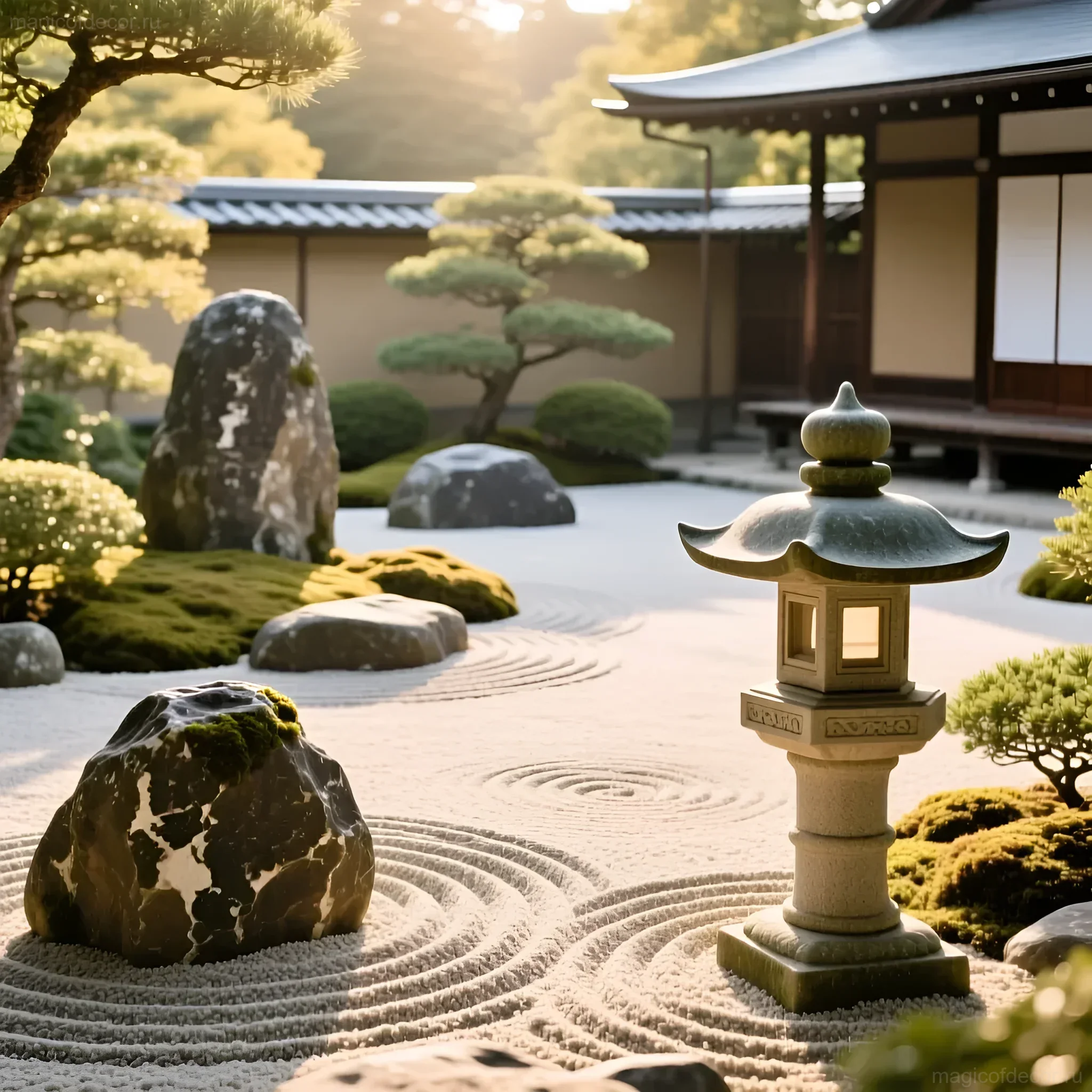
Dear friends, how often, arriving at the dacha, do we seek not just rest, but true peace? A place where you can shed the burden of worries, slow down, and simply be. If you dream of such a corner, but are not ready for large-scale landscaping, I have the perfect solution: a Japanese rock garden, or karesansui. It’s not just a decorative element, it’s a philosophy embodied in stone and sand. And most importantly – you don’t need hectares of land or heavy machinery to create it. Only your inspiration and a little patience!
Japanese Rock Garden at the Dacha: Inspiration and Zen Philosophy
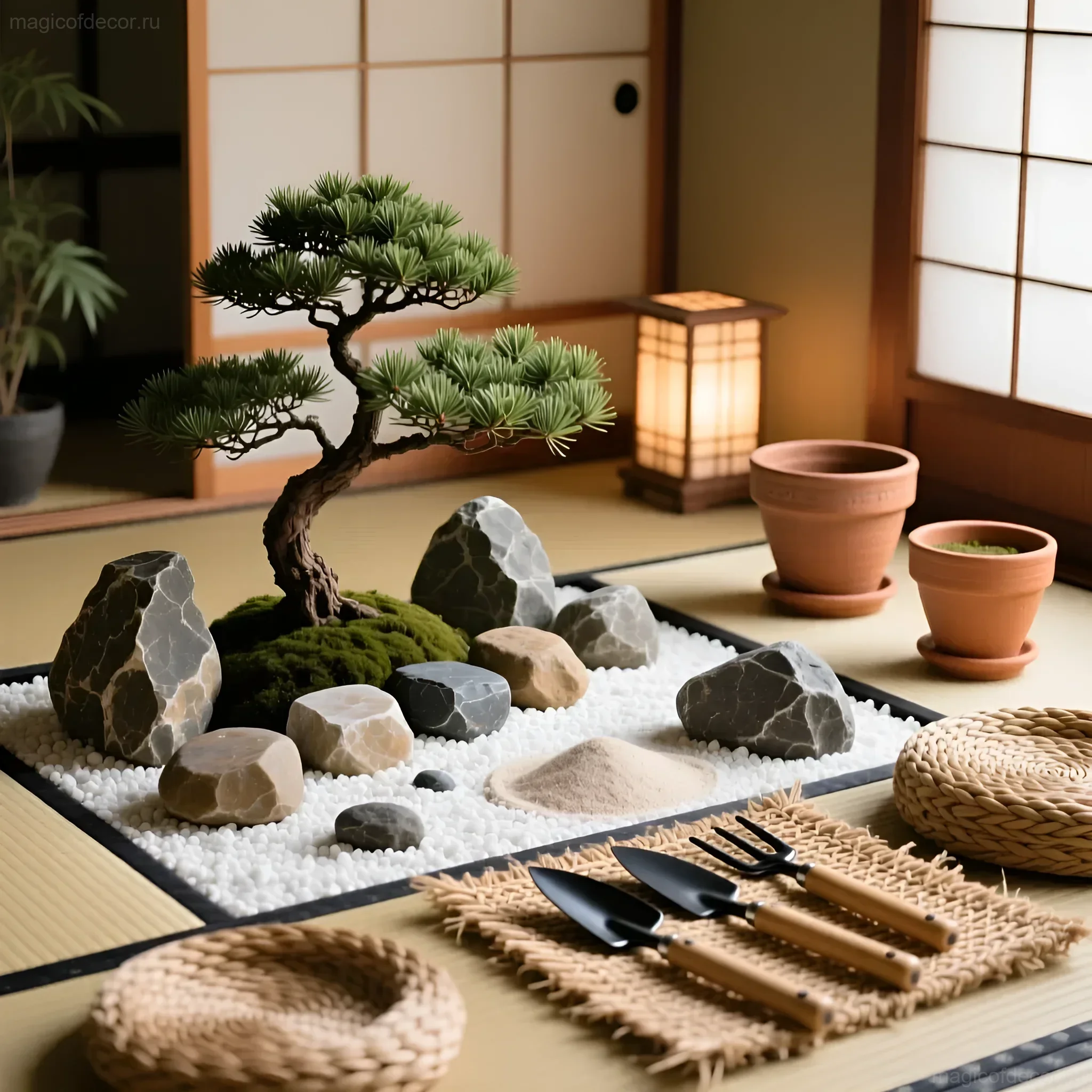
A rock garden is the art of minimalism, where each element carries deep meaning. Unlike lush European flowerbeds, a Zen garden strives for absolute simplicity. It symbolizes nature, but in an abstract form: gravel or sand is the ocean or river, and stones are islands or mountains. This is the perfect decor for a dacha, as it requires no complex care, and its creation is a form of meditation.
Remember, we are not creating a museum, we are creating a personal space for contemplation. Zen philosophy teaches us to see beauty in imperfection (wabi-sabi), so do not strive for perfect symmetry. On the contrary, asymmetry and an odd number of elements are the key to success.
- Ma (Ma): The principle of emptiness. The space between stones is as important as the stones themselves. It is a place for reflection.
- Stones (Ishi): Should be chosen for their shape and texture. They are constancy and strength.
- Gravel (Suna): Water that you draw with a rake. It is movement and changeability.
Materials for a Japanese Rock Garden: What You’ll Need to Create a Zen Space
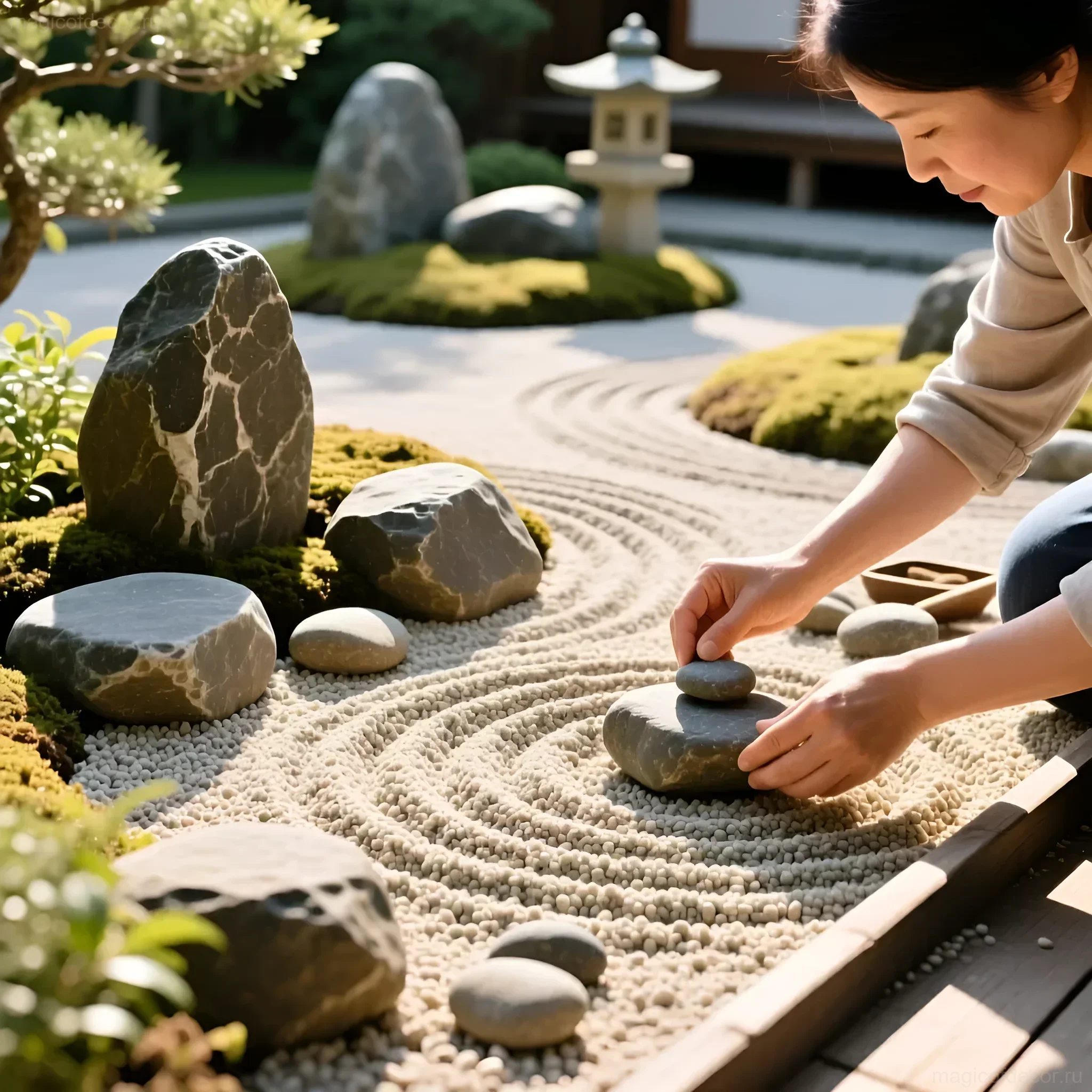
Before you start, let’s gather everything you need. The good news is that most materials can be found or purchased very affordably.
1. Stones (The Main Accents)
We will need three types of stones to create a composition resembling a mountain landscape. Use an odd number of stones (3, 5, 7, etc.).
- Main Stones (Vertical): Large, expressive boulders that will dominate. Granite or basalt are ideal.
- Flat Stones: For creating “islands” or “thresholds.”
- Small Stones: For framing the composition or creating a “dry stream.”
Decorator’s Tip: Look for stones with interesting textures, covered in moss or lichen. They will immediately add age and authenticity to the garden.
2. Fill Material (Water)
This is the foundation of your garden. Gravel, screenings, or coarse sand work best.
- Color: Traditionally, light-colored (white, light gray, cream) gravel is used to contrast with the stones and better “draw” waves.
- Fraction: Choose a fraction of 3–8 mm. Too fine sand will be blown away by the wind, and too coarse gravel will be difficult to rake.
3. Edging and Base
- Geotextile: A critically important element! It will prevent weeds from growing through the gravel and prevent the fill material from mixing with the soil.
- Border: To clearly separate the rock garden from the rest of the area. Wooden planks, natural stone, or concrete curbs (if they can be hidden) can be used.
- Tools: Shovel, level, hand rake, and, of course, a special rake for drawing on gravel (you can make one yourself, see the DIY section).
Step-by-Step Instructions: Creating a Japanese Rock Garden with Your Own Hands
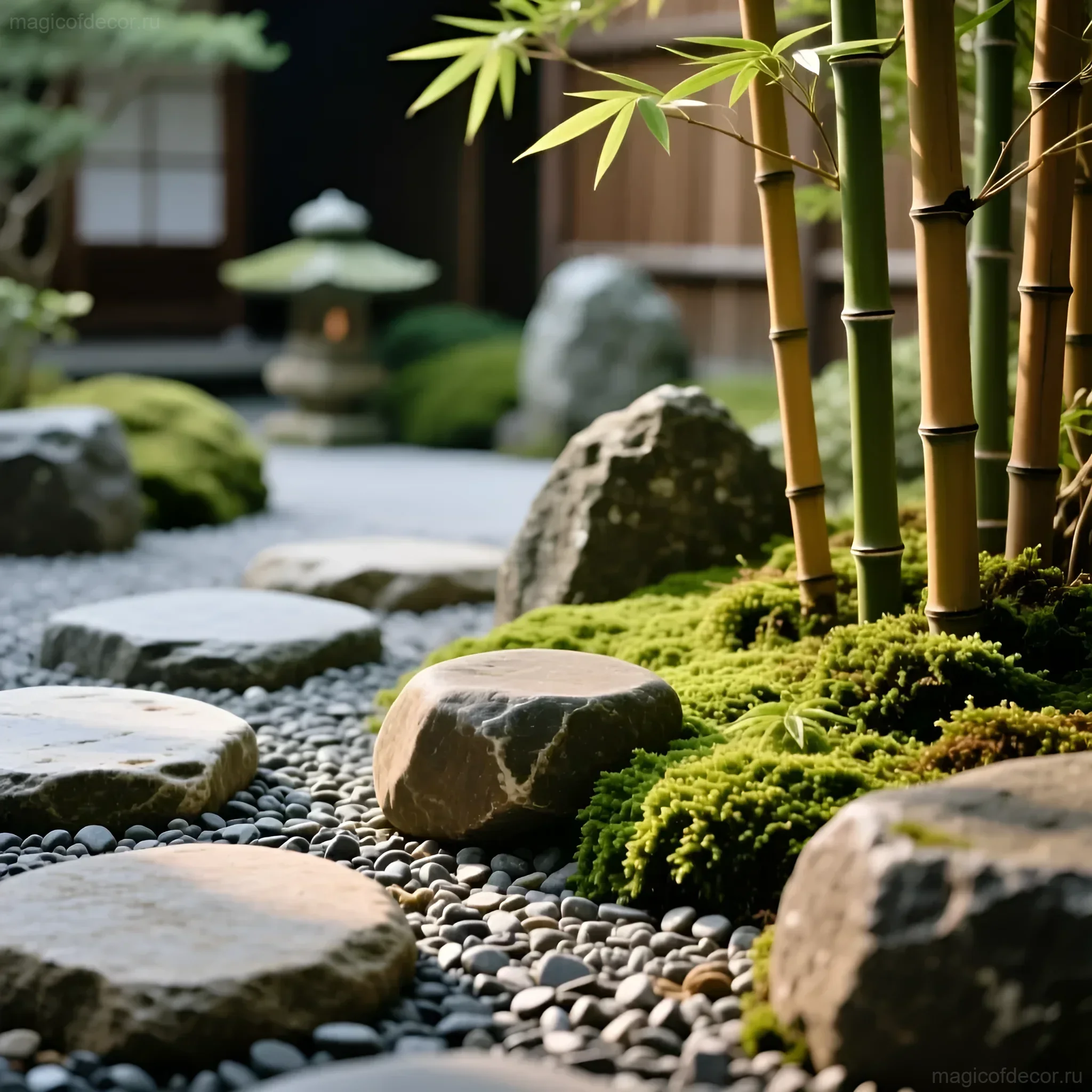
Creating a rock garden is not about rushing, but about ritual. Follow these steps, and you will get a perfect Zen corner.
Step 1: Choosing and Preparing the Site
Choose a quiet spot at your dacha where you can relax. Ideally, it should be a partially shaded area, protected from strong winds. The size doesn’t matter; even 1.5 x 2 meters will be enough.
- Clear the chosen area of weeds, sod, and debris.
- Dig a small depression (about 10–15 cm) to place the base.
- Install the border, clearly outlining the boundaries of the future garden.
Step 2: Drainage and Weed Protection
Weeds are the main enemy of a clean Zen garden. You need to create a reliable barrier.
- Cover the bottom of the excavated area with geotextile. Secure its edges so it doesn’t shift.
- If the soil is very clayey, you can add a thin layer of sand under the geotextile for better drainage.
Step 3: Placing the Main Stones
This is the most creative and important stage. The stones should look natural, as if they have always been there.
- Place the stones asymmetrically. Use groups of three or five.
- Secure the stones: to make them stable, embed them in the ground by 1/3 or 1/4 of their height.
- Pay attention to direction: the stones should “look” in the same direction, creating a sense of movement.
- Step back and evaluate the composition from different angles. The stones should not completely obscure each other.
Step 4: Filling with Gravel and Finishing Touches
After the stones are securely in place, you can fill in the “water.”
- Evenly distribute gravel or screenings over the entire area, avoiding direct contact with the edges of the stones.
- The layer thickness should be at least 5–7 cm, so you can easily draw waves.
- Lightly compact the gravel and level the surface.
Step 5: Drawing Waves (The Most Enjoyable Part)
Take your rake and start drawing. This is meditation.
Types of Patterns:
- Concentric Circles (Ripples): Drawn around the main stones, symbolizing waves radiating from an island.
- Straight Lines (Waves): Parallel lines symbolizing the calm flow of water.
- Wavy Lines: Used to create a “dry stream” that winds around the stones.
Color Palette and Textures: Harmony in a Japanese Garden
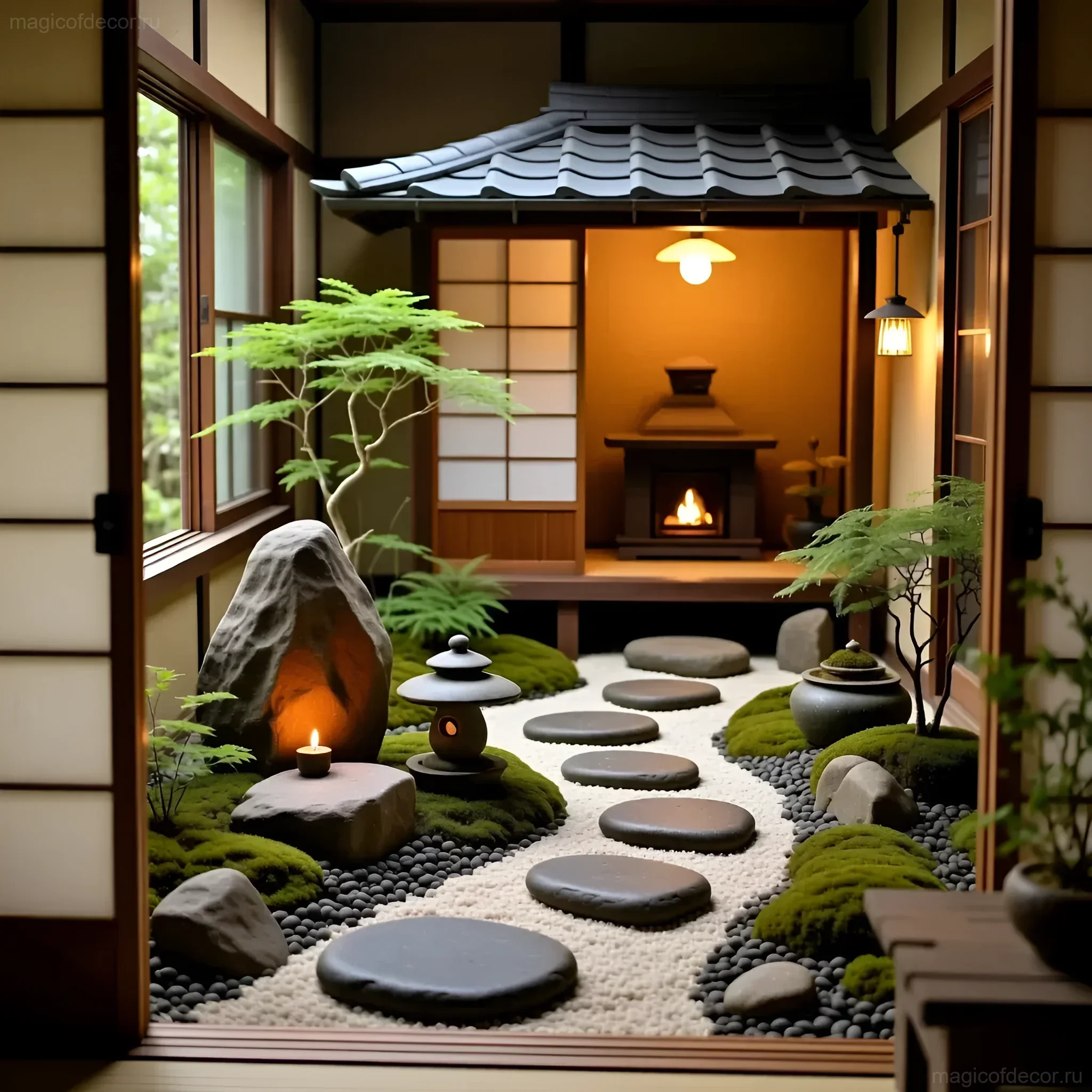
A Japanese rock garden works through contrast and restraint. Forget bright, flashy colors. Natural, earthy tones are valued here.
Color Scheme
The main palette consists of neutral and earthy tones:
- Gray and Black: For stones (granite, basalt). They give the composition weight and stability.
- White and Cream: For gravel. This color reflects light and creates the effect of a water surface.
- Green: Added very moderately, through moss, lichen, or dwarf plants. It symbolizes life and longevity.
- Brown: For wooden borders or benches.
Textural Balance
Harmony is created by contrasting surfaces:
| Texture Type | Element | Purpose |
|---|---|---|
| Rough, Coarse | Large boulders, unworked stone | Symbolizes rock, permanence. |
| Fine, Loose | Gravel, sand | Symbolizes water, changeability. |
| Soft, Velvety | Moss, low ground cover | Softens the hard lines of the stone, adds life. |
If you want to add greenery, choose plants that won’t distract from the stones. Dwarf pine trees, mosses, hostas, or irises (which symbolize water) are ideal.
Budget Japanese Rock Garden: How to Save Without Losing the Atmosphere
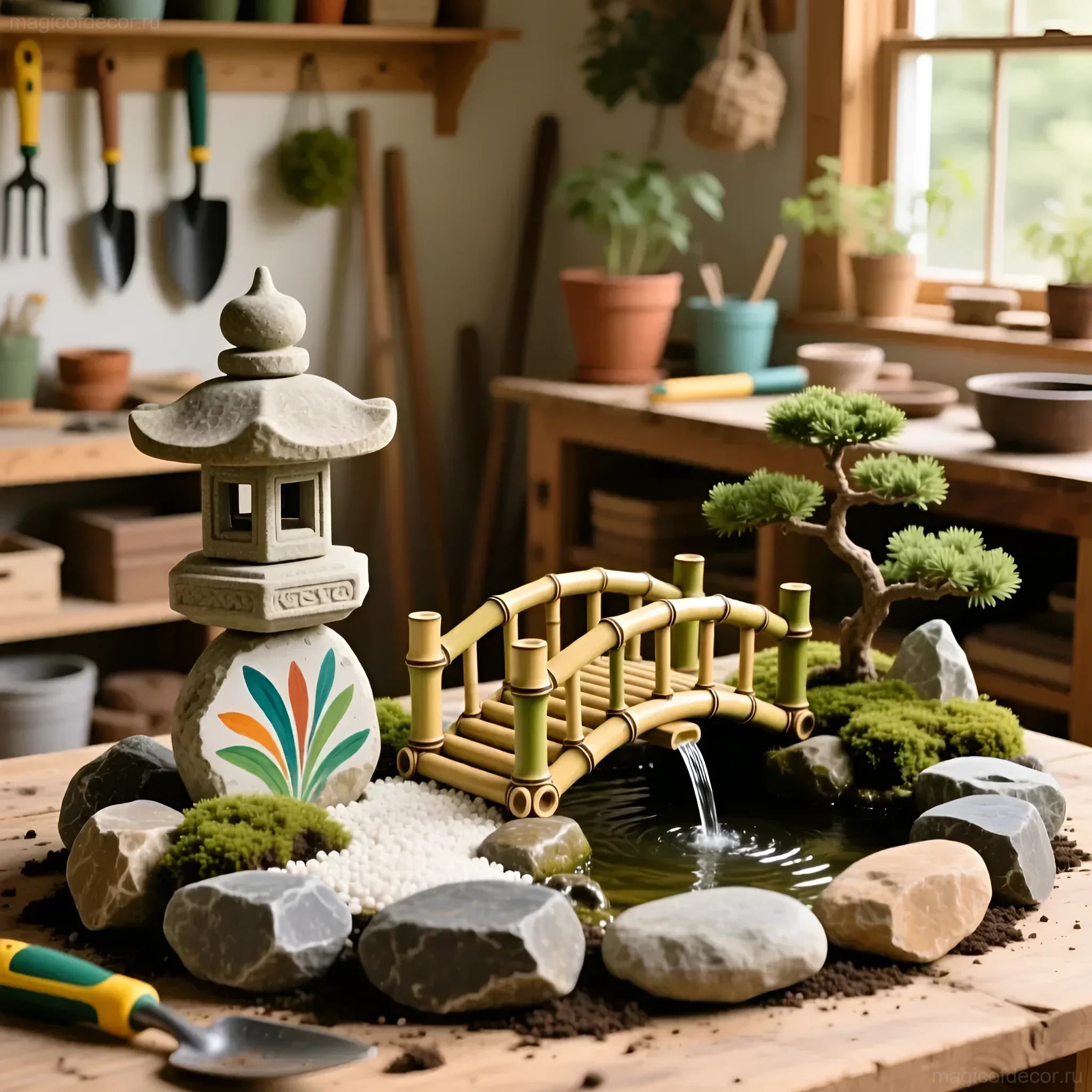
Creating a Zen corner shouldn’t empty your wallet. Many elements can be replaced or sourced yourself.
1. Stones: Finding and Processing
- Local Resources: Instead of buying expensive boulders at garden centers, take a walk around your dacha’s surroundings. You can often find beautiful stones in forests, on riverbanks, or in old quarries.
- Cleaning: If the stones are dirty, just wash them thoroughly with a stiff brush. Don’t try to polish them – natural patina is welcome.
2. Gravel: Alternatives
- Screenings: The most budget-friendly option. It’s a byproduct of stone crushing and costs significantly less than decorative gravel. The only drawback is that it needs to be thoroughly washed before use to remove dust.
- Mixture: Use more expensive, light-colored gravel only for the central, visible part, and cheaper dark screenings for the edges.
3. Edging and Borders
Instead of a stone border, which can be expensive and difficult to install:
- Use wooden planks treated with antiseptic and painted dark. They look minimalist and authentic.
- Flexible plastic edging (garden border), buried in the ground, will be invisible but effectively hold the gravel.
4. DIY Tools
Special rakes for drawing waves are expensive, but they are easy to make yourself:
- Take a regular small garden rake.
- Attach a wooden plank to its tines at a 5–7 cm interval (using screws or strong glue).
- Done! You have the perfect tool for creating straight, meditative lines.
DIY Projects for a Japanese Garden: Adding Individuality
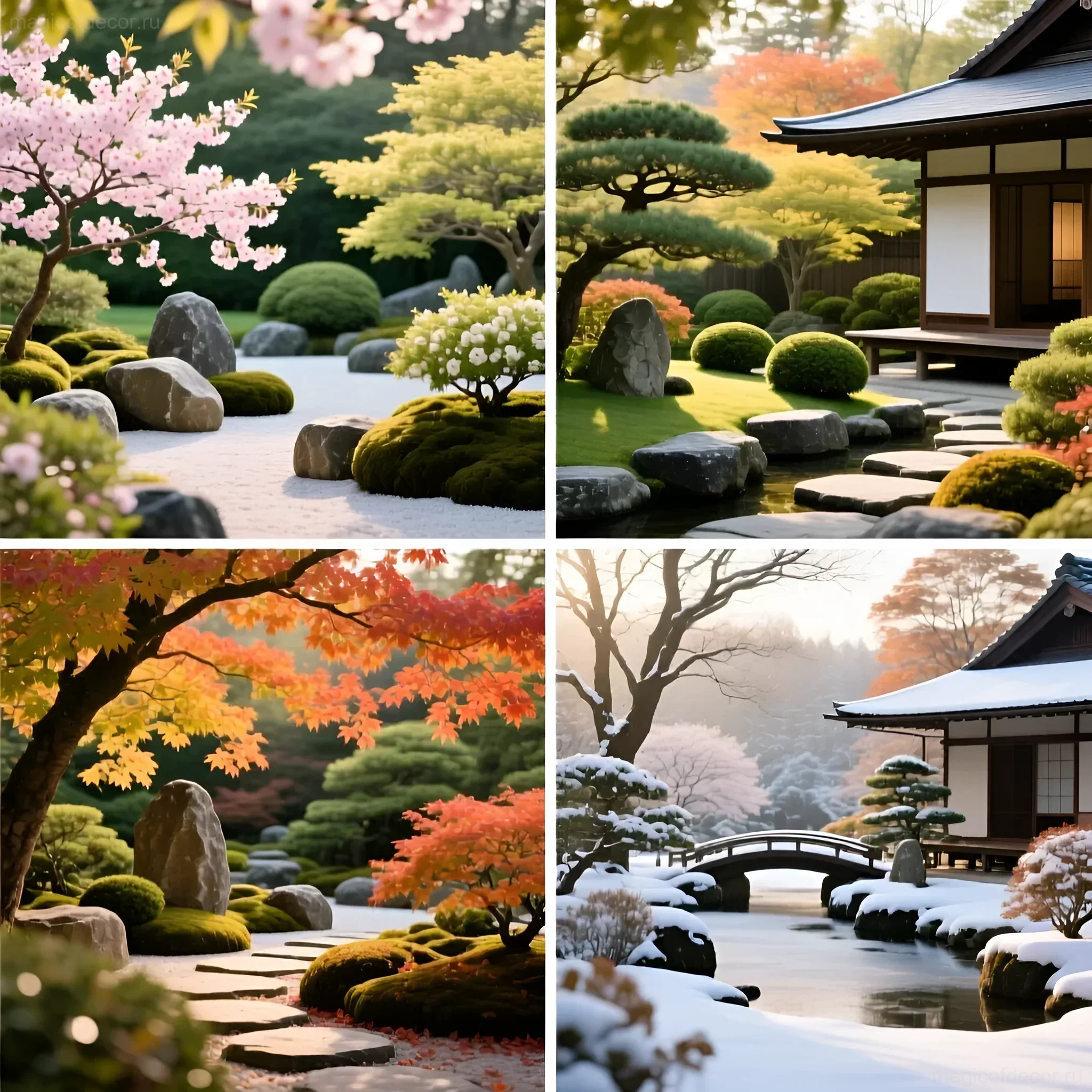
To make your Zen corner truly yours, add a few decorative elements made with your own hands.
1. Cement Stone Lantern (Toro)
The traditional Japanese lantern, Toro, symbolizes the light of knowledge. You can make it from readily available materials.
What you’ll need: Cement, sand, water, several plastic buckets of different sizes (to create tiers), cardboard tubes (for the base).
- Base: Mix a cement solution. Pour it into a large bucket to create the base.
- Base: Use a cardboard tube wrapped in plastic as a mold.
- Roof: The most complex part. You can use two bowls of different diameters to create a conical roof.
- Assembly: After complete drying (this will take several days), assemble the parts and paint them dark or leave them their natural gray color. You can place a solar-powered candle inside.
2. Mini Pond or Tsukubai
Tsukubai is a stone basin for washing hands, but in our case, it can become a symbolic water source.
- Take a large flat stone with a natural indentation or an old ceramic bowl.
- Bury the bowl or stone in the gravel in a corner of the garden.
- Place a bamboo stick nearby, which will symbolize a water tap. If you want a real fountain, use a small circulation pump and a hose hidden under the gravel.
- Add a few small moss-covered stones nearby.
3. Homemade Contemplation Bench
To fully enjoy the garden, you need a place to sit. Make a simple minimalist bench.
- Use a wide, thick board (moisture-treated).
- For legs, you can use two low, thick stumps or two identical vertical stones.
- Place the bench so that it offers an ideal view of your stone composition.
Japanese Rock Garden Through the Seasons: Seasonal Accents
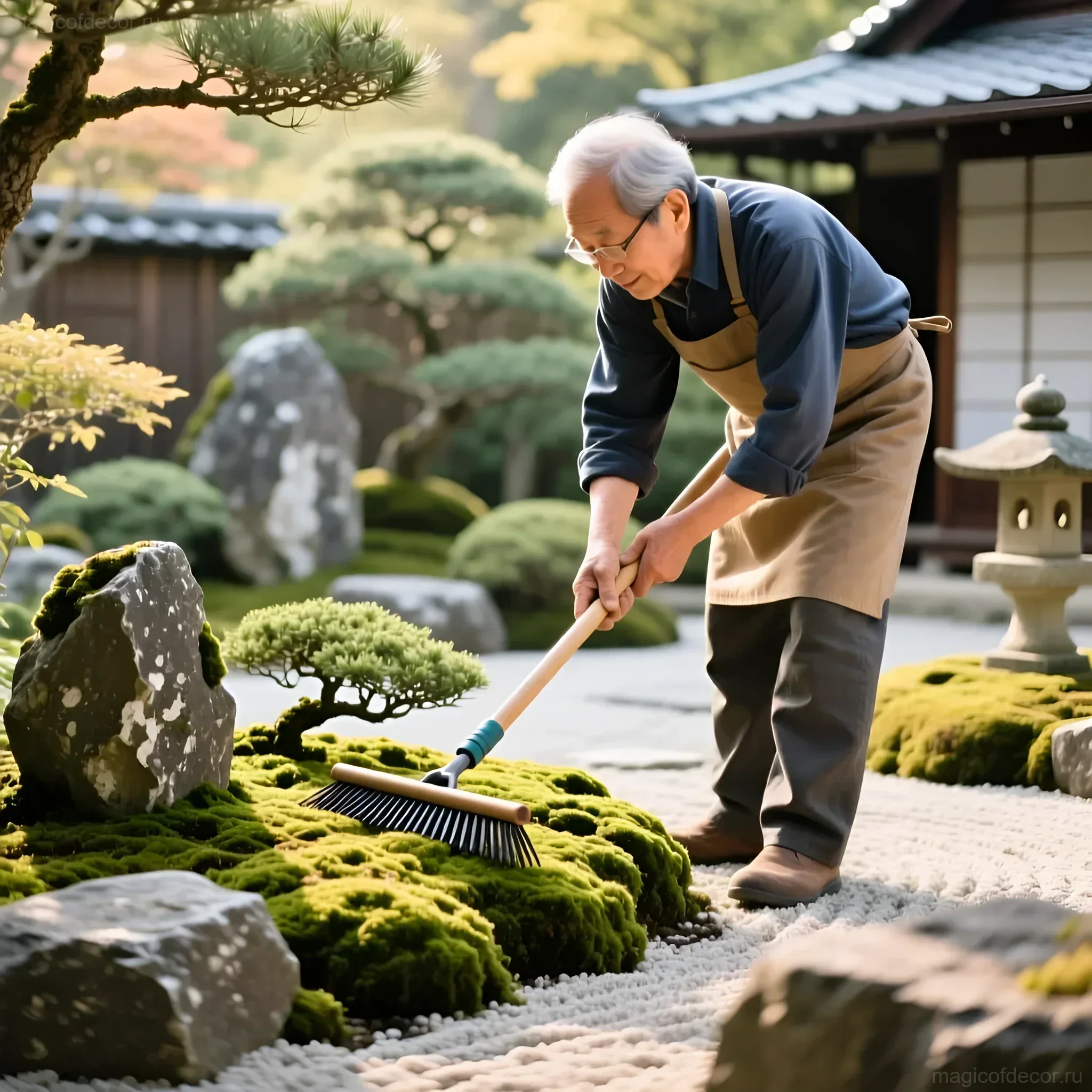
The beauty of a rock garden lies in its stability. It is beautiful in winter and summer. However, we can add seasonal touches without disturbing the overall harmony.
Spring: Awakening and Purity
In spring, your garden needs a thorough cleaning. Collect fallen leaves, refresh the pattern with a rake.
- Accent: Plant a few low-growing spring flowers (crocuses or early irises) in pots near the border. The pots can be easily removed after flowering, preserving the garden’s minimalism.
Summer: Greenery and Contrast
In summer, the main task is to keep the gravel clean and prevent weeds from growing (if you used geotextile, this will be easy).
- Accent: Add decorative hostas or ferns in ceramic pots that resemble stones to the composition. Their lush but restrained greenery will add depth.
- Care: Regularly refresh the gravel pattern with a rake. This helps to relax on a hot day.
Autumn: Melancholy and Fading
In autumn, the rock garden takes on a particularly thoughtful appearance. Fallen leaves can be a problem.
- Care: Use a garden vacuum cleaner (on the blower setting) or a wide broom to gently remove leaves without disturbing the gravel pattern.
- Accent: You can add a pot of chrysanthemums (a traditional Japanese autumn flower) or a decorative pumpkin next to the Toro lantern.
Winter: Silence and Peace
In winter, the Zen garden transforms into a snow garden. Snow covering the stones creates a completely new, no less beautiful composition.
- Care: Do not try to clear the snow! Let nature be the decorator.
- Accent: Make sure your stone lantern or tsukubai can withstand frost.
Expert Tips: Secrets to Creating an Authentic Japanese Rock Garden
To make your dacha Zen corner look not just like a pile of stones, but like a harmonious composition, adhere to these unwritten rules.
1. The Principle of “Hidden Stone” (Miegakure)
Don’t show everything at once. Stones should be arranged so that, looking at the garden, you feel that something is hidden. This creates a sense of depth and mystery. For example, one stone might be almost completely submerged in gravel, while another is hidden behind a tall boulder.
2. Asymmetry and Odd Numbers
In a Japanese garden, symmetry is taboo. Use odd numbers for stone groups (3, 5, 7). Arrange them according to the principle of a “triangle” or “diagonal” (where one stone dominates, and two others support the composition).
3. Interaction with the Surroundings
Your rock garden should be integrated into the dacha landscape. Use surrounding trees or shrubs as a “background curtain.” If there is an old wall or fence nearby, it’s an ideal backdrop. You can decorate it with bamboo mats or simple wooden slats.
4. Viewing Angle
A traditional rock garden is meant to be contemplated from one point (e.g., from a veranda or bench). Ensure that your composition looks most impressive from this particular angle. The stones should “lead” the viewer’s gaze.
5. Regular Raking Meditation
Do not perceive gravel care as hard work. It is part of Zen practice. Drawing waves helps to clear the mind. Do it regularly, and your garden will always look fresh and well-maintained.
Creating a Japanese rock garden at your dacha is an incredibly inspiring project that will bring peace and beauty into your life. It is your personal, quiet place where you can feel at one with nature, even if potatoes are growing outside the border. Good luck, and may your rock garden be filled with Zen!